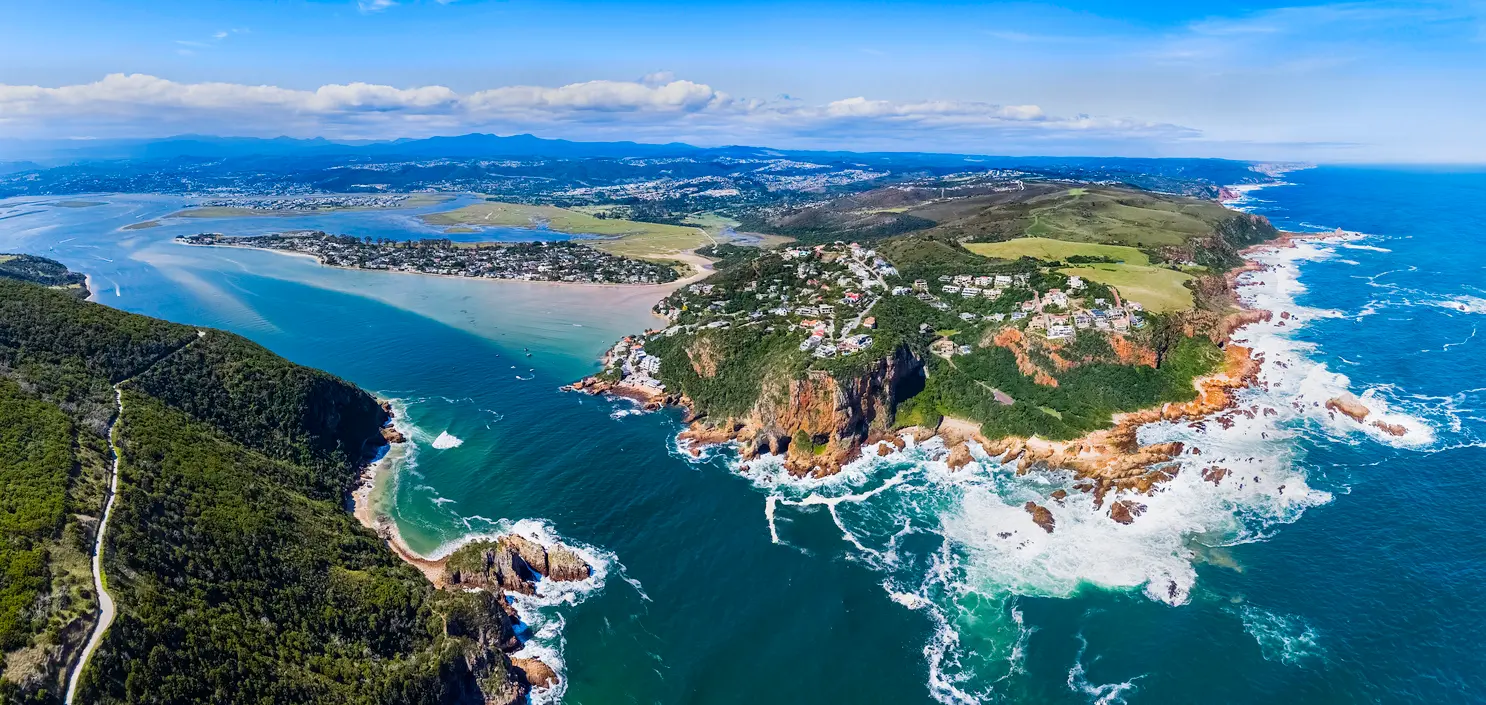
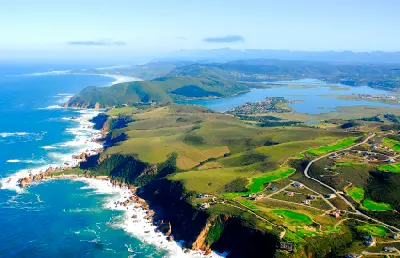
Aerial view of Knysna Heads, where towering coastal cliffs frame the narrow entrance between the Indian Ocean and Knysna Lagoon along South Africa’s Garden Route.
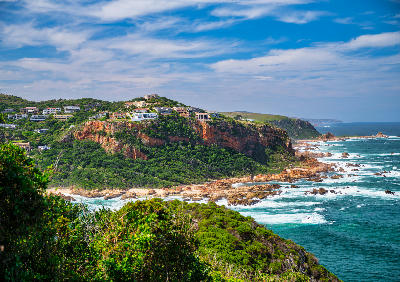
Knysna & Lagoon Forests form the ecological and visual heart of the Garden Route, where a vast tidal lagoon, indigenous forests, estuarine waterways, dramatic sandstone headlands, and forested hills combine to create one of South Africa's most iconic coastal landscapes. Centered around the Knysna Lagoon and its famous Heads, the region is defined by the interaction between ocean, estuary, forest, and mountain. Deep indigenous forests descend toward sheltered waterways, while rocky cliffs guard the narrow entrance connecting the lagoon to the Indian Ocean. Unlike Sedgefield's open wetland systems or Plettenberg Bay's expansive beaches and marine scenery, Knysna is characterised by enclosed waterways, forested hillsides, estuarine channels, and one of the most visually distinctive lagoon landscapes in Africa.
Gallery
Key POIs in Knysna & Lagoon Forests
Nearby Places
View all on mapSedgefield & Coastal Lakes
area district — 23.1 km
Garden Route
Swartvlei Estuary
water feature — 25.4 km
Garden Route
Gericke's Point
landmark — 26.2 km
Garden Route
Plettenberg Bay & Robberg
area district — 30.1 km
Garden Route
Lookout Beach
beach — 30.4 km
Garden Route
Beacon Isle
landmark — 30.5 km
Garden Route
Keurbooms River Mouth
landmark — 31.4 km
Garden Route
Robberg Nature Reserve
landmark — 32.8 km
Garden Route
Overview
The Knysna region occupies a unique position within the Garden Route where freshwater river systems, indigenous forests, estuarine environments, and coastal marine processes converge. The landscape is structured around the Knysna Lagoon, a large tidal estuary extending inland from the Indian Ocean through a narrow rocky entrance known as the Knysna Heads. Surrounding the lagoon are extensive indigenous forests that form part of the larger Garden Route forest ecosystem. Forested hills, rocky headlands, sheltered bays, tidal channels, and estuarine islands create an exceptionally varied landscape with strong visual contrasts between water, woodland, and coastline. Photographically, the region works through layering, atmosphere, and elevation. Elevated viewpoints reveal complex relationships between lagoon, forest, estuary, and ocean, while shoreline locations provide opportunities for reflections, changing tides, mist, and dramatic coastal weather. The interaction between water and forest is a defining visual characteristic throughout the region.
Key photography subjects
- The Knysna Heads and lagoon entrance
- Tidal estuary landscapes and reflective waterways
- Indigenous forests and ancient woodland scenery
- Elevated viewpoints overlooking lagoon systems
- Forested hillsides descending toward the estuary
- Rocky coastal headlands and cliff formations
- Mist and atmospheric conditions across forests and waterways
- Coastal storms, changing tides, and dramatic light
Workshops in Knysna & Lagoon Forests
No upcoming workshops scheduled for Knysna & Lagoon Forests at this time.
Check back soon or explore other destinations.