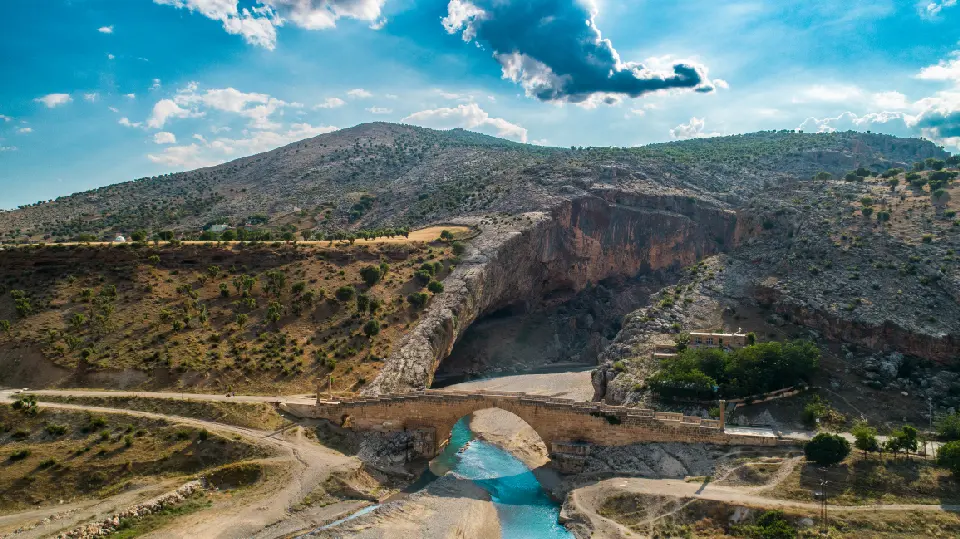
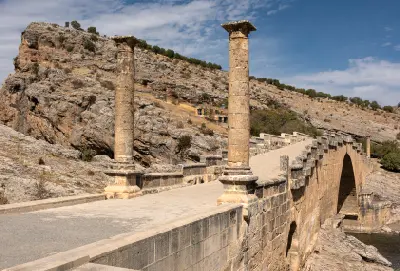
Cendere Bridge spans a dramatic rocky gorge in the mountainous landscape near Kahta, southeastern Turkey.
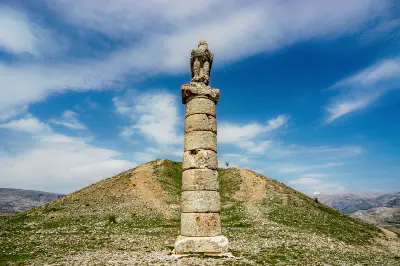
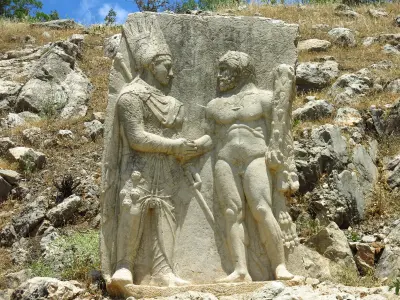
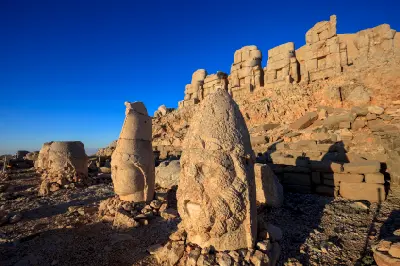
Mount Nemrut & Commagene form one of southeastern Turkey’s most distinctive archaeological landscapes, where monumental ancient remains occupy rugged mountains overlooking the upper Euphrates region. At its centre is the summit sanctuary of Mount Nemrut, created by King Antiochus I of Commagene and renowned for its colossal stone heads, monumental statues, and immense artificial burial mound. The wider landscape preserves a network of sites associated with the ancient Kingdom of Commagene. Arsameia occupies a strategic hillside above the Nymphaios Valley, while the Roman Cendere Bridge crosses a narrow rocky gorge and the Karakuş Tumulus marks a royal burial monument on the surrounding plains. Together these sites reveal how architecture, religion, and royal power were embedded within the natural landscape. Steep mountains, dry valleys, exposed ridges, and broad horizons give the region a strongly monumental character. Seasonal vegetation and changing atmospheric conditions alter the appearance of the terrain, while clear mountain light, dramatic skies, and long views towards the surrounding ranges reinforce the sense of isolation and scale.
Gallery
Key POIs in Mount Nemrut & Commagene
Overview
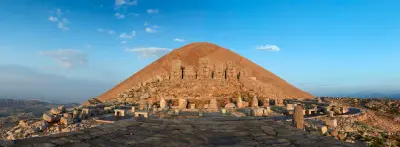
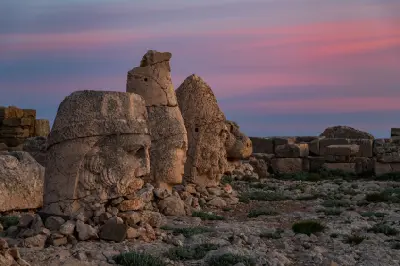
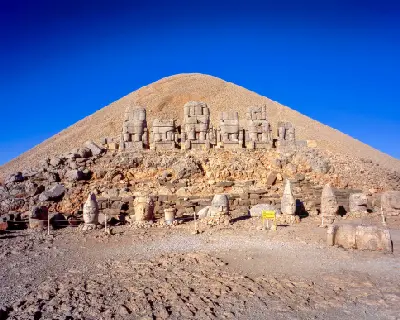
The landscape is centred on Mount Nemrut, where King Antiochus I of Commagene constructed an extraordinary sanctuary during the first century BCE. An enormous artificial tumulus crowns the summit, flanked by terraces containing colossal statues representing the king, deities, and symbolic figures. Centuries of weathering and seismic activity separated many of the statues' heads from their bodies, creating the remarkable archaeological landscape visible today. Beyond the summit, the surviving monuments of Commagene are distributed across the surrounding mountains and valleys. Arsameia served as an important royal centre, while Karakuş Tumulus commemorated members of the royal family and the Cendere Bridge demonstrates the continuing strategic importance of the region under Roman rule. Mountain roads, river valleys, archaeological remains, and isolated monuments collectively reveal a landscape shaped by successive periods of settlement and political control. Photographically, the region is defined by the relationship between monumental archaeology and an expansive mountain setting. The colossal heads and statues of Mount Nemrut provide powerful foreground subjects against distant ridges and open skies, while Arsameia, Karakuş, and Cendere offer contrasting compositions of ruins, columns, bridges, and rugged terrain. Sunrise and sunset are particularly distinctive on the exposed summit, when low-angle light, silhouettes, changing colour, and atmospheric mountain layers emphasise the extraordinary setting of the sanctuary.
Key photography subjects
- Colossal stone heads and monumental statues of Mount Nemrut
- Summit terraces, burial mound, and expansive mountain panoramas
- Arsameia and ancient Commagene archaeological remains
- Cendere Bridge, rocky gorge, and Roman engineering
- Karakuş Tumulus and surviving monumental columns
- Rugged mountains, river valleys, and dry highland landscapes
- Sunrise, sunset, silhouettes, and dramatic mountain light
Workshops in Mount Nemrut & Commagene
No upcoming workshops scheduled for Mount Nemrut & Commagene at this time.
Check back soon or explore other destinations.