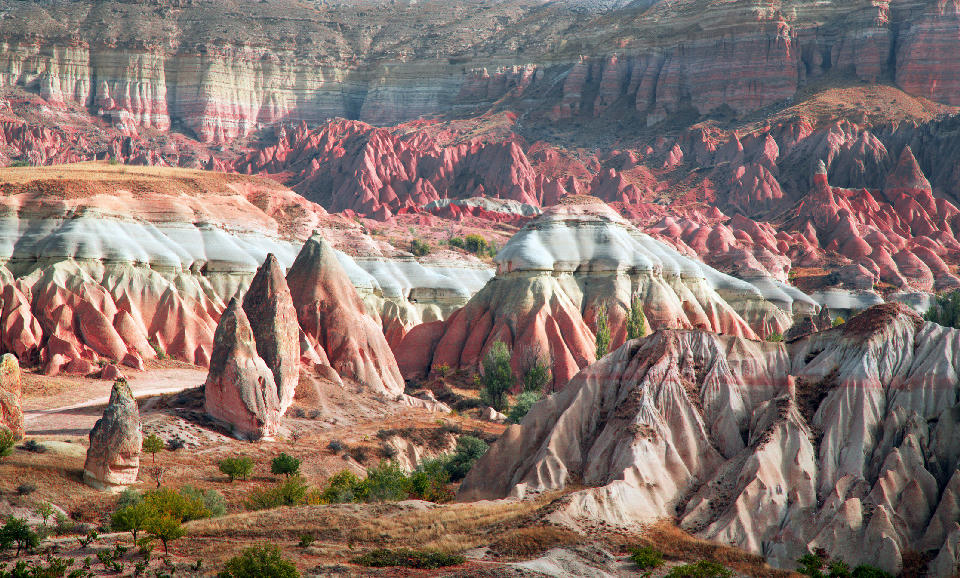
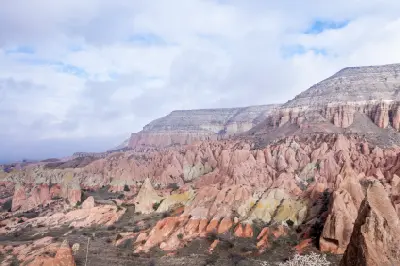
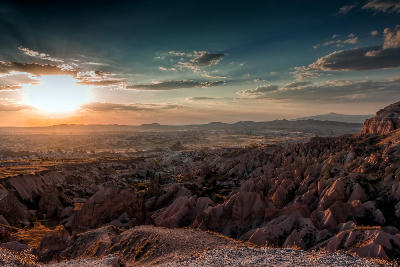
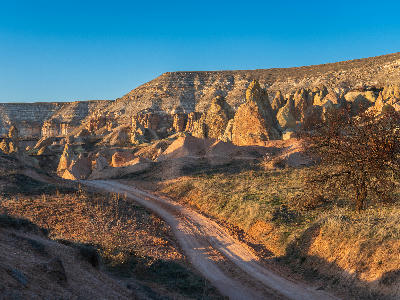
The striking layered cliffs and colourful volcanic ridges of Red Valley create one of Cappadocia's most dramatic landscapes, glowing in shades of crimson, pink, and white.
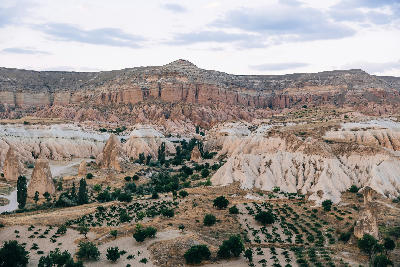
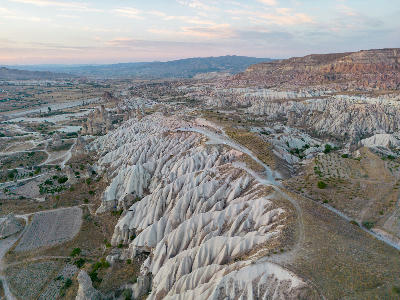
Red Valley is an eroded volcanic valley near Göreme, distinguished by layered ridges and rock formations containing red, pink and ochre mineral tones. The colours become particularly visible when low sunlight reaches the exposed volcanic tuff, contrasting with the paler landscapes found elsewhere in Cappadocia. Trails wind between narrow gullies, cave openings and weathered cliffs before climbing towards elevated viewpoints. Together with neighbouring Rose Valley, it forms one of Cappadocia's principal hiking landscapes.
38.65099, 34.85359
Gallery
Quick Facts
Access
Moderate Hike
45–90 min
Elevation Gain
150 m
Best Light
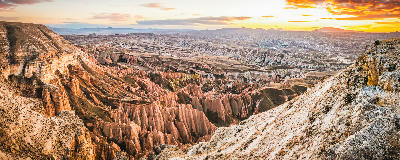
Late-afternoon light strengthens the red and ochre tones of the volcanic rock while revealing texture across the layered ridges and cliffs.
Why This Light
Season
Year-Round Stable
Spring and autumn generally bring mild temperatures and comfortable conditions for exploring the exposed trails and ridges. Winter can bring snow across the coloured formations, while summer is typically hot and dry with stronger contrast across the valley.
Crowds
Often Busy
Restrictions
Red Valley can be explored on hiking trails connecting the valley floor, surrounding ridges and neighbouring Rose Valley. Routes vary in length and include uneven surfaces and steeper sections, while several elevated sunset viewpoints can be reached with considerably shorter walks.