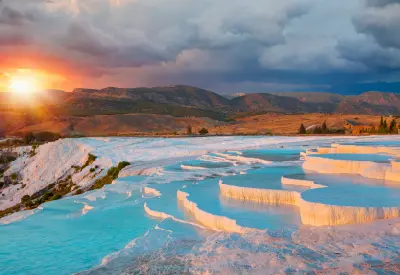
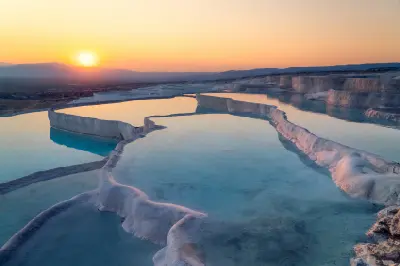
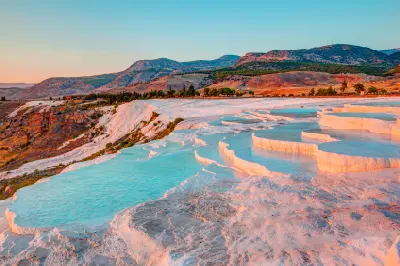
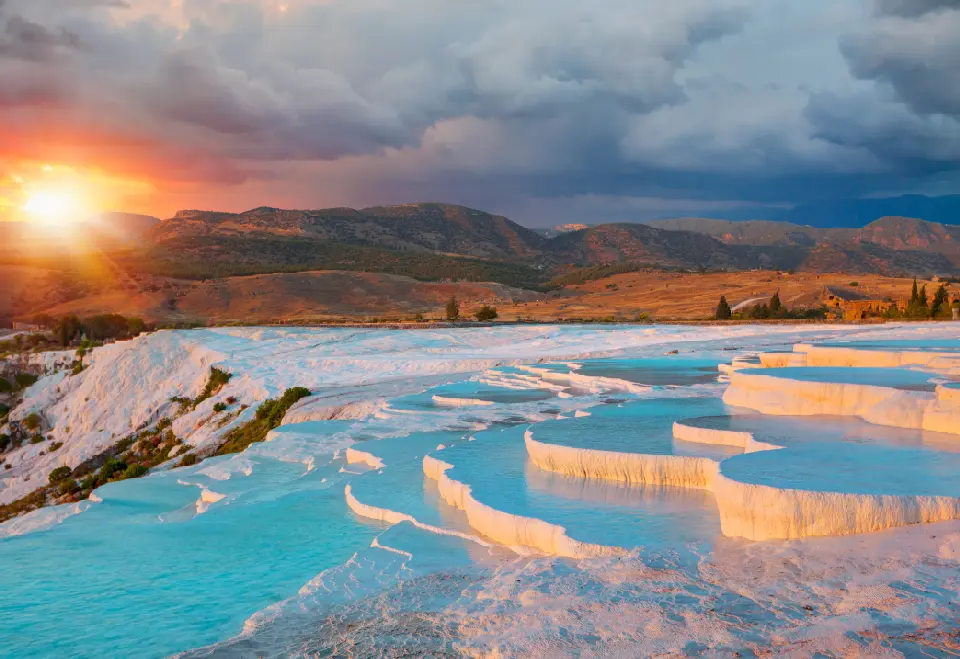
White travertine terraces filled with turquoise thermal water at Pamukkale, Turkey, illuminated by a dramatic sunset over the surrounding mountains.

    Pamukkale’s spectacular white travertine terraces and thermal pools glowing in the light of sunset.

    Pamukkale & Ancient Wonders

    Pamukkale & Ancient Wonders brings together one of western Turkey’s most distinctive natural landscapes with an exceptional concentration of archaeological sites. Brilliant white travertine terraces, thermal springs, ancient cities, temples, theatres, and monumental ruins reflect thousands of years of geological and human history across the valleys of inland Aegean Turkey.

    Pamukkale is formed by mineral-rich thermal waters flowing across a hillside above the remains of ancient Hierapolis, creating terraces and pools of white calcium carbonate. Nearby archaeological landscapes extend across the wider region, where Greek, Roman, Byzantine, and earlier civilizations established major cities along important trade routes and fertile river valleys.

    The combination of geology, monumental architecture, open countryside, and archaeological remains gives the region considerable visual variety. Seasonal vegetation, changing water levels, atmospheric conditions, and strong Mediterranean light continually alter the relationship between pale stone, white travertine, surrounding mountains, and agricultural plains.

    Geographic discovery

    Explore Pamukkale & Ancient Wonders by Area

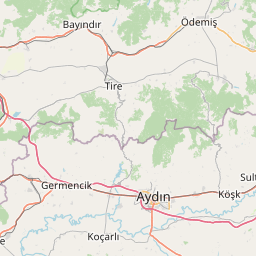
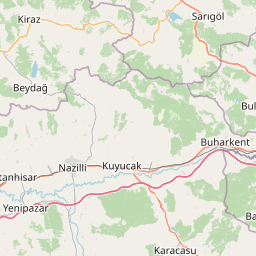
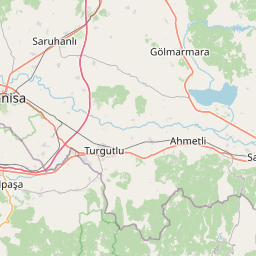
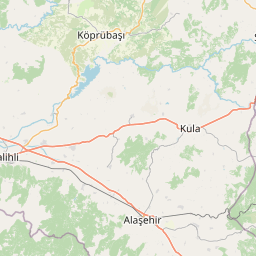
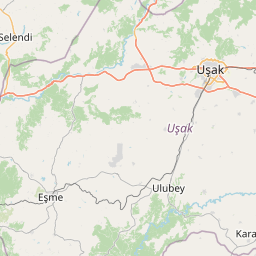
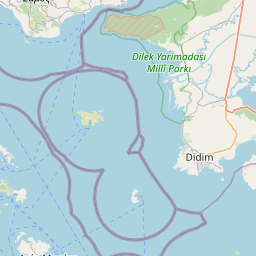
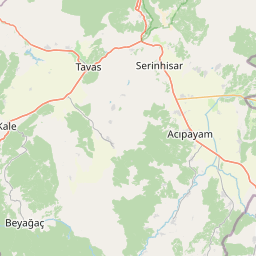
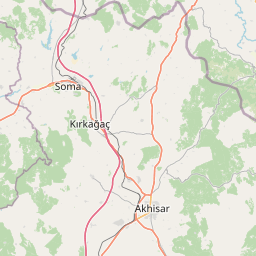
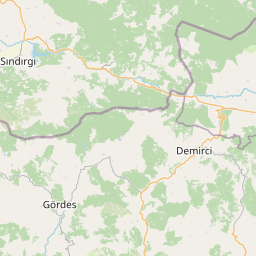
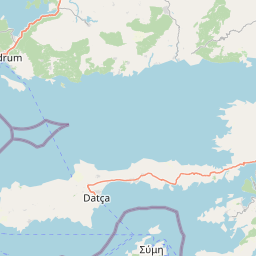
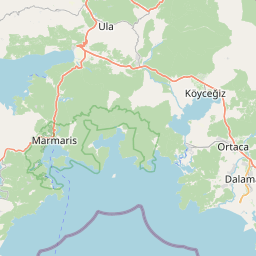
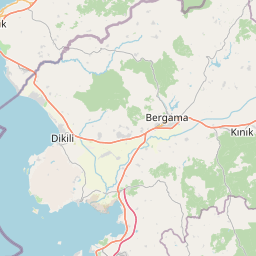
    Choose a part of Pamukkale & Ancient Wonders to discover its landscapes, photographic character, and locations.

    Open interactive Explore

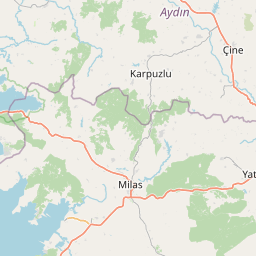
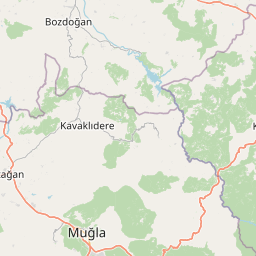
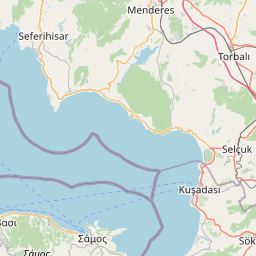
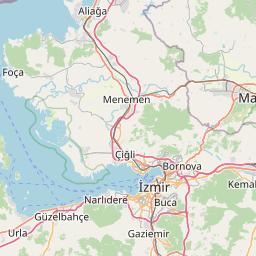
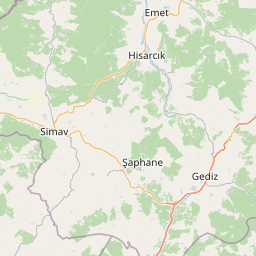
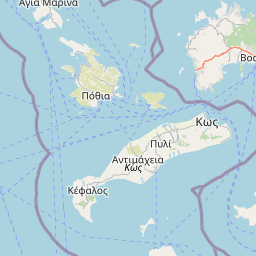
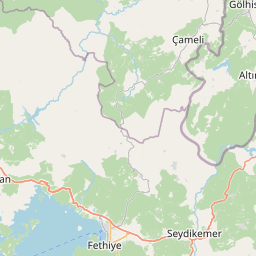
    Explore Areas in Pamukkale & Ancient Wonders

    Open in Explore
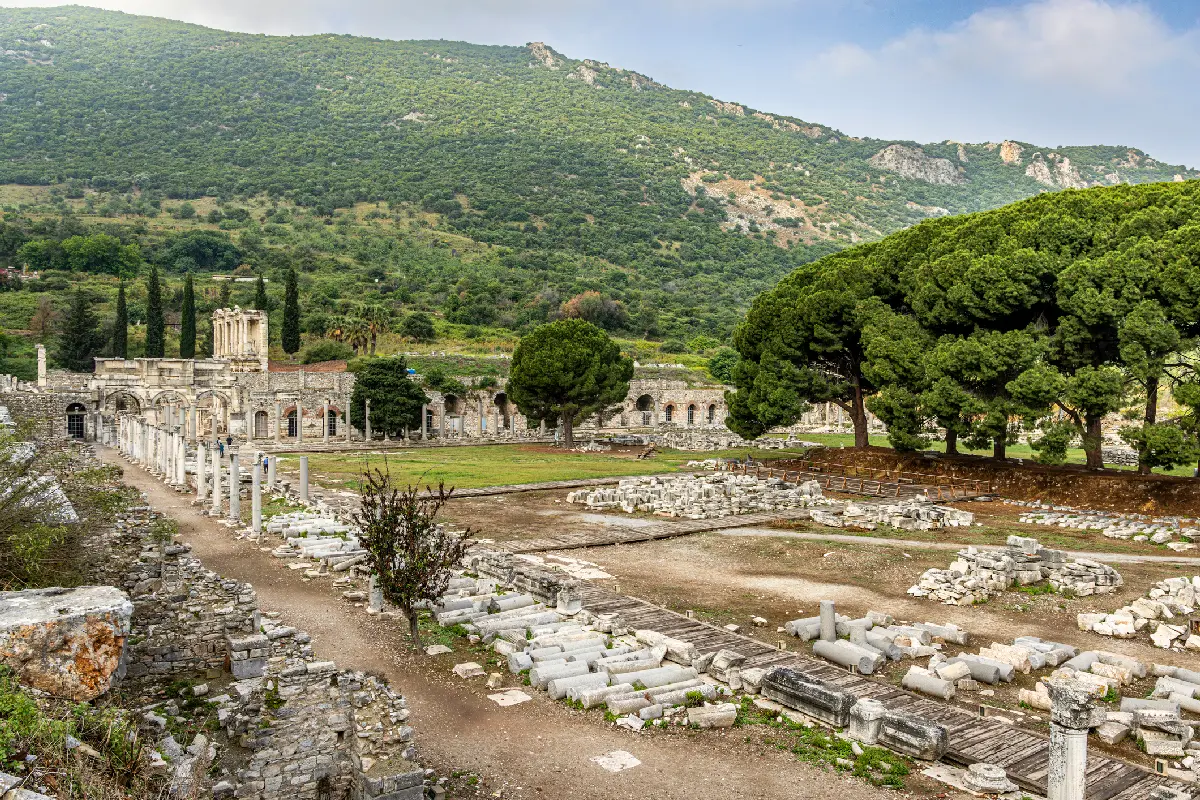
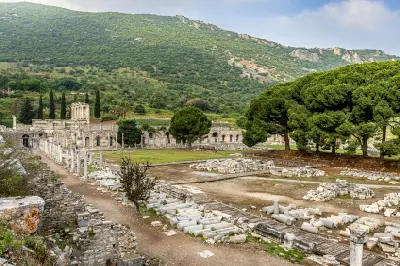
    Wide view of the ancient ruins of Ephesus, with marble columns, scattered stone remains and monumental structures set against green hills near Selçuk, Turkey.

    Ephesus

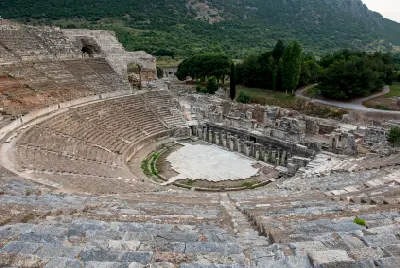
    Ephesus developed around one of the most important urban and commercial centres of ancient western Anatolia. Its surviving streets and buildings reveal the organisation of a major Greco-Roman city, with monumental gateways, temples, baths, fountains, civic buildings, residential quarters, and entertainment venues connected by broad stone and marble streets. The archaeological remains extend across a large area, creating a remarkably coherent ancient urban landscape. Among its defining structures are the Library of Celsus, with its reconstructed monumental façade, and the Great Theatre, which rises dramatically against the surrounding hillside. Curetes Street forms one of the city's strongest visual axes, lined by columns and architectural remains as it descends through the site. The nearby Temple of Artemis survives only fragmentarily, but its archaeological setting represents an important part of the wider historical landscape of Ephesus. Photographically, Ephesus works through architecture, perspective, repetition, and the relationship between ancient structures and the surrounding terrain. Marble streets create strong leading lines, while columns, arches, carved stone, statues, and monumental façades provide subjects at multiple scales. Elevated viewpoints reveal the structure of the ancient city, while early and late light, cloud, shadow, and seasonal vegetation can bring depth and atmosphere to the weathered stone.

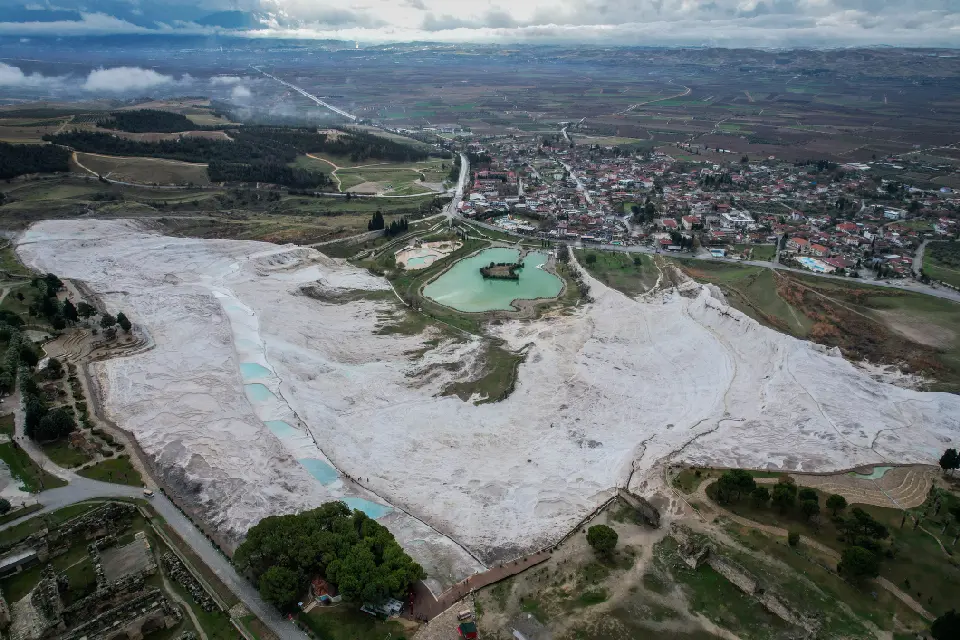
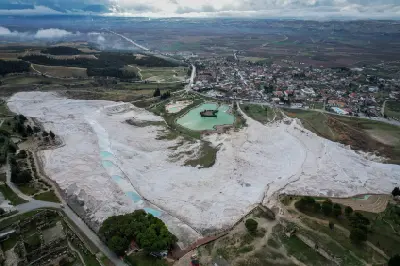
    Aerial view of Pamukkale, Turkey, showing the white travertine terraces, turquoise pools, nearby Hierapolis ruins and the town and countryside beyond.

    Pamukkale

    Pamukkale’s terraces were formed as calcium-rich thermal water emerged from natural springs and flowed across the hillside, depositing successive layers of travertine. Over thousands of years this process created stepped terraces, mineral ridges, channels, shallow pools, and flowing white surfaces. Water continues to shape the formations, making the travertines a living geological landscape rather than a static rock formation. The plateau immediately above the terraces contains the remains of Hierapolis, whose development was closely associated with the thermal springs. Monumental ruins extend across a broad archaeological landscape, including the Roman theatre, ancient streets and gateways, bath complexes, temples, tombs, and a vast necropolis. From elevated sections of the site, the white travertines contrast strongly with the agricultural plains and distant mountains of the Büyük Menderes valley. Photographically, Pamukkale works through texture, reflection, repetition, and the relationship between geology and archaeology. Close compositions reveal mineral patterns, flowing water, and abstract terrace forms, while elevated viewpoints show the scale of the white hillside against the surrounding landscape. Hierapolis adds columns, stone architecture, and monumental structures, while sunrise, sunset, cloud, mist, and changing water conditions continually transform the colour and atmosphere of the site.

    Photographic journey

    Pamukkale & Ancient Wonders Photography Route

    Pamukkale & Ancient Wonders Circuit · 8 stops

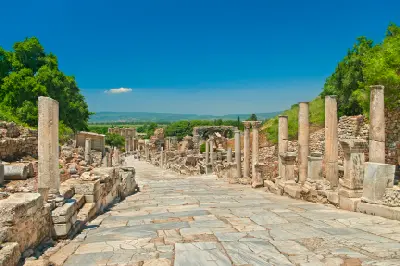
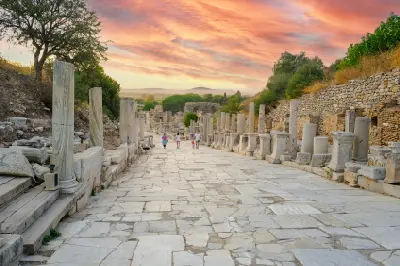
    Wide marble street lined with ancient columns and ruins, descending toward the Library of Celsus at Ephesus beneath a clear blue sky.01

    Curetes Street

    Curetes Street is one of the principal surviving streets of ancient Ephesus, descending through the city between the upper settlement and the Library of Celsus. Its marble-paved route is lined with columns, building façades, statues, fountains and the remains of important civic structures. The sloping street provides a clear view through layers of Roman architecture towards the library below. Surviving features along the route include the Temple of Hadrian, Fountain of Trajan and entrances to the Terrace Houses.

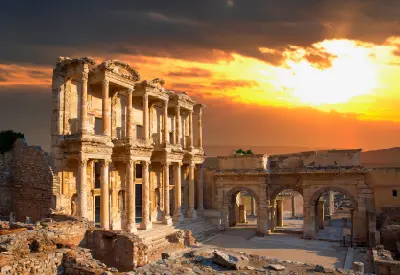
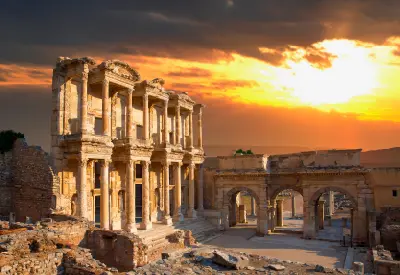
    Library of Celsus and surrounding Roman ruins at Ephesus beneath a dramatic golden sunset sky.02

    Library of Celsus

    The Library of Celsus is one of the best-preserved and most recognisable monuments within the ancient city of Ephesus. Constructed during the Roman period in the 2nd century AD, the building was created as both a library and a monumental tomb for the Roman senator Tiberius Julius Celsus Polemaeanus. Its reconstructed two-storey façade is defined by columns, niches, statues and richly carved architectural details. The library stands at the lower end of Curetes Street within the wider archaeological city.

    Wide view of the ancient ruins of Ephesus, with marble columns, scattered stone remains and monumental structures set against green hills near Selçuk, Turkey.04

    Ephesus

    Ephesus developed around one of the most important urban and commercial centres of ancient western Anatolia. Its surviving streets and buildings reveal the organisation of a major Greco-Roman city, with monumental gateways, temples, baths, fountains, civic buildings, residential quarters, and entertainment venues connected by broad stone and marble streets. The archaeological remains extend across a large area, creating a remarkably coherent ancient urban landscape. Among its defining structures are the Library of Celsus, with its reconstructed monumental façade, and the Great Theatre, which rises dramatically against the surrounding hillside. Curetes Street forms one of the city's strongest visual axes, lined by columns and architectural remains as it descends through the site. The nearby Temple of Artemis survives only fragmentarily, but its archaeological setting represents an important part of the wider historical landscape of Ephesus. Photographically, Ephesus works through architecture, perspective, repetition, and the relationship between ancient structures and the surrounding terrain. Marble streets create strong leading lines, while columns, arches, carved stone, statues, and monumental façades provide subjects at multiple scales. Elevated viewpoints reveal the structure of the ancient city, while early and late light, cloud, shadow, and seasonal vegetation can bring depth and atmosphere to the weathered stone.

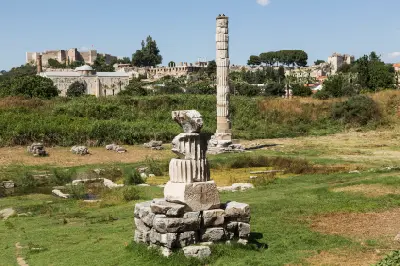
    Remains of the Temple of Artemis at Ephesus, including a tall reconstructed marble column amid a grassy archaeological site.05

    Temple of Artemis

    The Temple of Artemis near Selçuk was one of the Seven Wonders of the Ancient World and among the largest temples constructed in the ancient Mediterranean. Dedicated to the goddess Artemis, the monumental Ionic temple was rebuilt several times before its eventual destruction and abandonment. Very little of the original structure survives above ground today, with a reconstructed column rising among scattered stone remains across the archaeological site. Its photographic significance lies primarily in documenting the surviving traces and historical setting of a once extraordinary ancient monument.

    Aerial view of Pamukkale, Turkey, showing the white travertine terraces, turquoise pools, nearby Hierapolis ruins and the town and countryside beyond.07

    Pamukkale

    Pamukkale’s terraces were formed as calcium-rich thermal water emerged from natural springs and flowed across the hillside, depositing successive layers of travertine. Over thousands of years this process created stepped terraces, mineral ridges, channels, shallow pools, and flowing white surfaces. Water continues to shape the formations, making the travertines a living geological landscape rather than a static rock formation. The plateau immediately above the terraces contains the remains of Hierapolis, whose development was closely associated with the thermal springs. Monumental ruins extend across a broad archaeological landscape, including the Roman theatre, ancient streets and gateways, bath complexes, temples, tombs, and a vast necropolis. From elevated sections of the site, the white travertines contrast strongly with the agricultural plains and distant mountains of the Büyük Menderes valley. Photographically, Pamukkale works through texture, reflection, repetition, and the relationship between geology and archaeology. Close compositions reveal mineral patterns, flowing water, and abstract terrace forms, while elevated viewpoints show the scale of the white hillside against the surrounding landscape. Hierapolis adds columns, stone architecture, and monumental structures, while sunrise, sunset, cloud, mist, and changing water conditions continually transform the colour and atmosphere of the site.

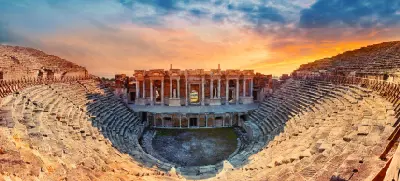
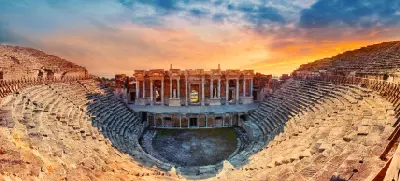
    Panoramic view of the ancient Roman Theatre of Hierapolis, with its tiered stone seating and monumental stage façade beneath a dramatic sunset sky.08

    Hierapolis

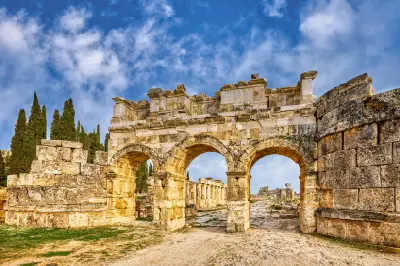
    Hierapolis is an extensive ancient city occupying the plateau directly above the Pamukkale Travertines. Established in the Hellenistic period and later developed under Roman rule, the city grew around the area's thermal springs and became an important spa and religious centre. Surviving structures include a large Roman theatre, monumental gateways, temples, baths and one of Anatolia's most extensive ancient necropolises. The ruins spread across an open plateau overlooking the surrounding landscape.

    Explore the Full Pamukkale & Ancient Wonders Circuit8 stops across Pamukkale & Ancient Wonders

    Overview

    The landscape is anchored by Pamukkale’s travertine formations and the extensive ruins of Hierapolis occupying the plateau immediately above them. Thermal water has shaped the hillside over thousands of years, producing cascading white terraces, mineral deposits, and shallow pools, while the ancient city contains monumental gates, streets, baths, temples, a theatre, and one of Anatolia’s largest surviving necropolises.

    Beyond Pamukkale, the wider region contains important archaeological landscapes associated with successive Anatolian, Greek, Roman, and Byzantine civilizations. Ancient cities and monumental ruins occupy plains, hillsides, and elevated sites, creating a broader historical landscape in which architecture and archaeology remain closely connected to the geography of western Turkey.

    Photographically, the region works through texture, geometry, scale, and the contrast between natural and constructed forms. Travertine terraces create abstract patterns and reflections, while columns, theatres, temples, and weathered stone provide strong architectural subjects. Elevated viewpoints, low-angle sunlight, mist, clouds, and golden-hour light can reveal layers of mountains and plains behind the archaeological sites.
    Key Photography Subjects

    • Pamukkale’s white travertine terraces and thermal pools
    • Hierapolis ruins, theatre, and monumental architecture
    • Ancient temples, columns, gateways, and stone streets
    • Archaeological sites within the western Anatolian landscape
    • Travertine textures, mineral patterns, water, and reflections
    • Mountain backdrops, agricultural plains, and elevated viewpoints
    • Sunrise, sunset, mist, and golden light across ancient stone

    Gallery

    Workshops in Pamukkale & Ancient Wonders

    No upcoming workshops scheduled for Pamukkale & Ancient Wonders at this time.

    Check back soon or explore other destinations.