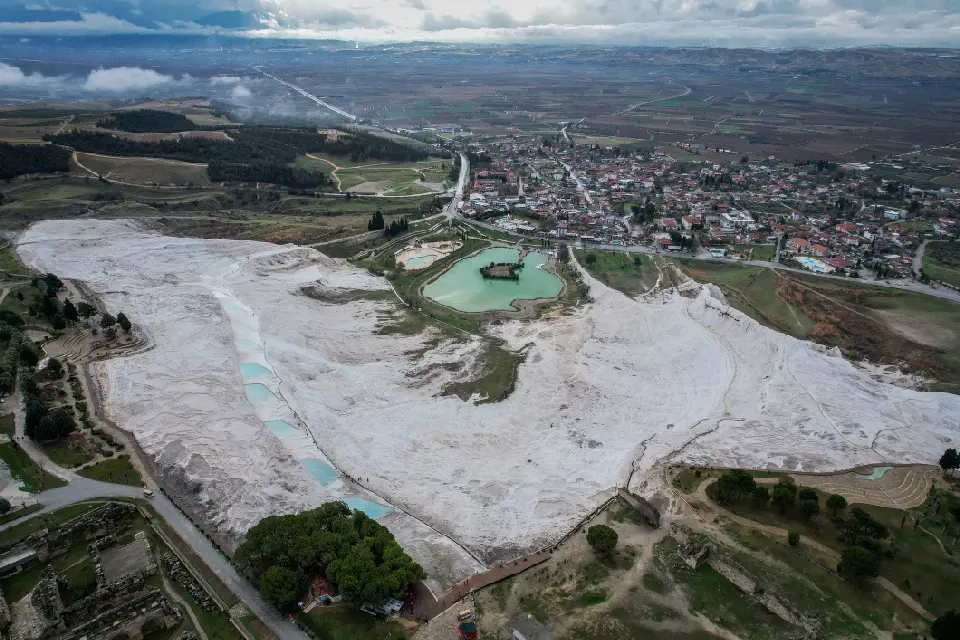
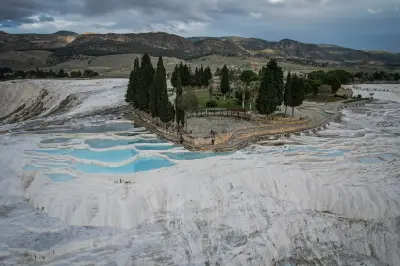
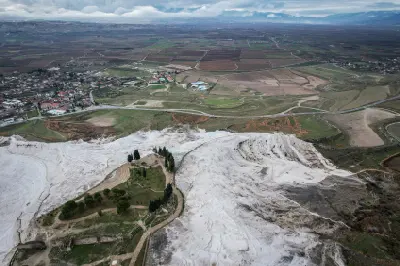
An aerial view of Pamukkale, where the vast white travertine terraces meet the ancient landscape of Hierapolis and the surrounding Denizli countryside.
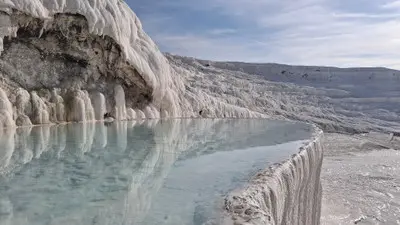
Pamukkale is one of Turkey’s most distinctive geological and archaeological landscapes, where brilliant white travertine terraces descend across a hillside above the Büyük Menderes valley. Mineral-rich thermal waters have flowed across the slope for thousands of years, depositing calcium carbonate and creating a landscape of stepped terraces, shallow pools, mineral channels, and sculpted white formations. Immediately above the travertines lies Hierapolis, an ancient Greco-Roman and Byzantine city established around the area’s thermal springs. Its theatre, monumental streets, gates, baths, temples, and extensive necropolis occupy the plateau behind the terraces, creating an unusual landscape in which natural formations and archaeological remains are directly connected. The appearance of Pamukkale changes considerably with water, weather, season, and light. Shallow pools can reflect the sky, wet travertine takes on subtle blue and silver tones, and the surrounding valley shifts between green agricultural landscapes and the drier colours of summer, while mist, cloud, and low sunlight can dramatically alter the white formations.
Gallery
Key POIs in Pamukkale
Overview
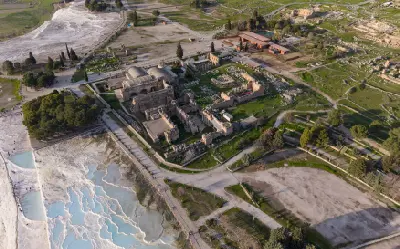
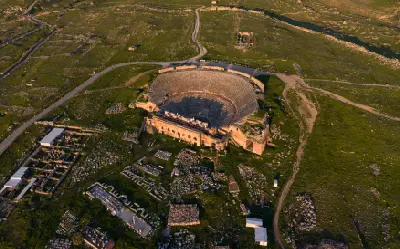
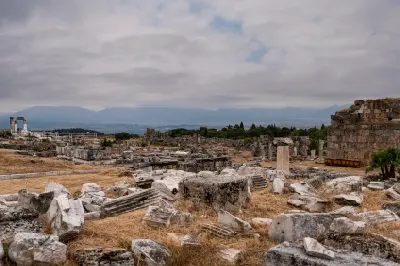
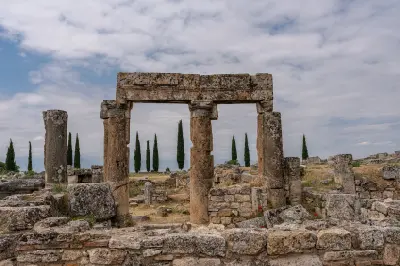
Pamukkale’s terraces were formed as calcium-rich thermal water emerged from natural springs and flowed across the hillside, depositing successive layers of travertine. Over thousands of years this process created stepped terraces, mineral ridges, channels, shallow pools, and flowing white surfaces. Water continues to shape the formations, making the travertines a living geological landscape rather than a static rock formation. The plateau immediately above the terraces contains the remains of Hierapolis, whose development was closely associated with the thermal springs. Monumental ruins extend across a broad archaeological landscape, including the Roman theatre, ancient streets and gateways, bath complexes, temples, tombs, and a vast necropolis. From elevated sections of the site, the white travertines contrast strongly with the agricultural plains and distant mountains of the Büyük Menderes valley. Photographically, Pamukkale works through texture, reflection, repetition, and the relationship between geology and archaeology. Close compositions reveal mineral patterns, flowing water, and abstract terrace forms, while elevated viewpoints show the scale of the white hillside against the surrounding landscape. Hierapolis adds columns, stone architecture, and monumental structures, while sunrise, sunset, cloud, mist, and changing water conditions continually transform the colour and atmosphere of the site.
Key photography subjects
- White travertine terraces and calcium-carbonate formations
- Thermal pools, reflections, channels, and flowing mineral water
- Hierapolis theatre, ruins, and monumental architecture
- Ancient streets, columns, gateways, and archaeological remains
- Abstract mineral textures, patterns, and cascading terraces
- Elevated views across the travertines and Büyük Menderes valley
- Sunrise, sunset, mist, cloud, and changing light across the white terraces
Workshops in Pamukkale
No upcoming workshops scheduled for Pamukkale at this time.
Check back soon or explore other destinations.