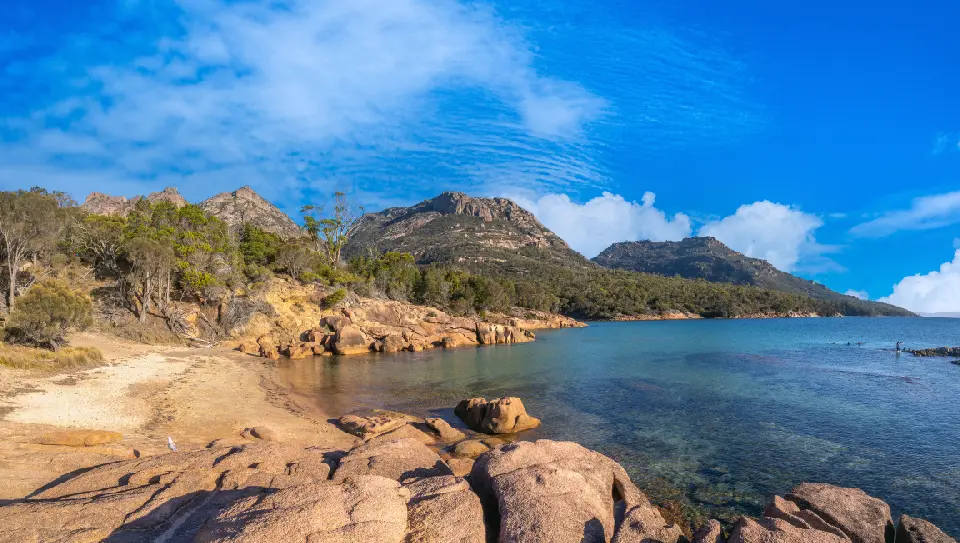
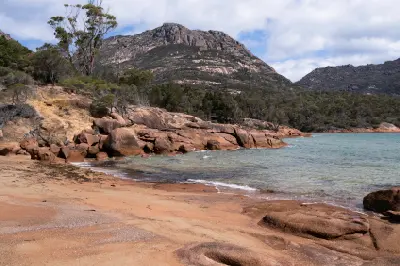
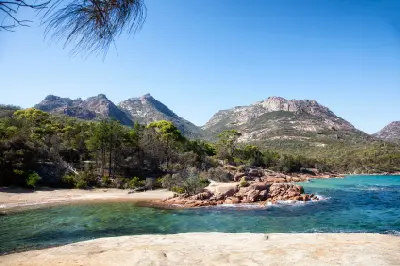
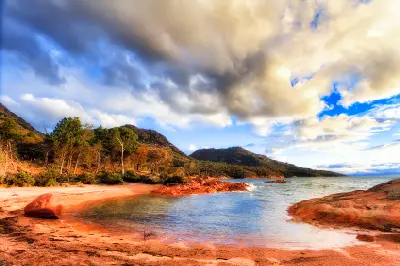
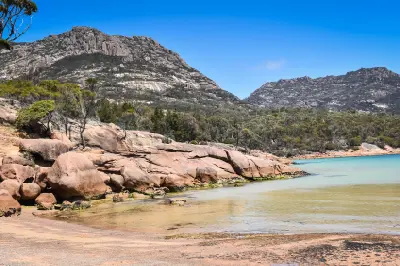
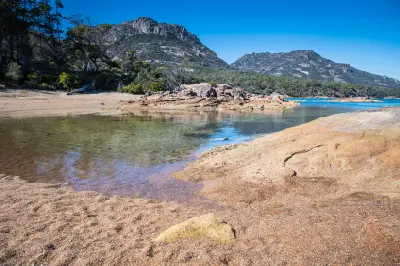
The five peaks of The Hazards rise behind the sheltered granite shoreline of Honeymoon Bay in Freycinet National Park, Tasmania.
Honeymoon Bay is a small sheltered cove on the Freycinet Peninsula, where clear water meets smooth granite rocks beneath the peaks of the Hazards. The compact shoreline combines pink-grey granite, coastal vegetation and calm water within a naturally enclosed bay. Its close relationship with the surrounding mountains makes it particularly useful for photographing the characteristic granite-and-water landscapes of Freycinet.
-42.13876, 148.29681
Gallery
Quick Facts
Access
Short Walk
0–5 min
Elevation Gain
5 m
Best Light
Why This Light
Season
Seasonally Distinct
Summer brings warmer conditions, clear water and the highest visitor numbers. Autumn and spring are cooler and quieter, while winter can provide crisp air, subdued coastal colour and more changeable weather.
Crowds
Often Busy
Restrictions
Honeymoon Bay lies within Freycinet National Park and is reached by a very short walk from nearby parking. The rocky shoreline is straightforward to explore, although granite surfaces can become slippery when wet. A valid Tasmania Parks Pass is required for park entry.