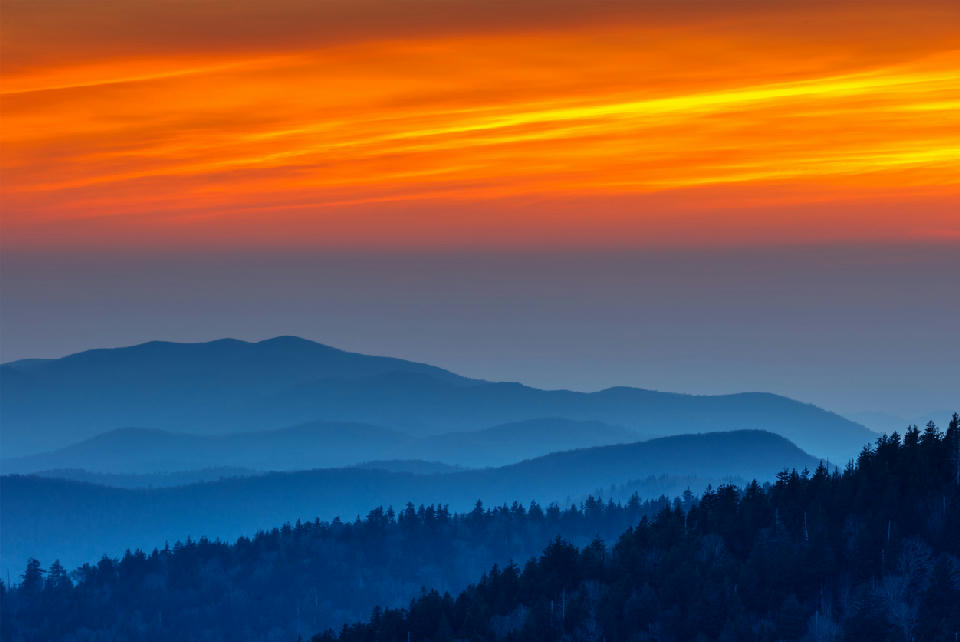
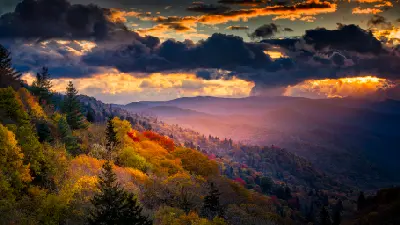
Layered blue ridgelines fade into the distance beneath a fiery sunset sky near Clingmans Dome in Great Smoky Mountains National Park, Tennessee, USA.
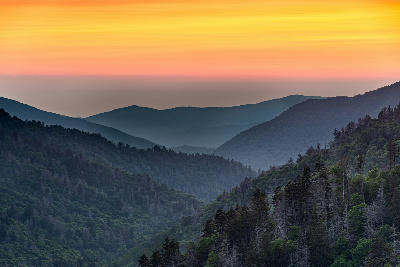
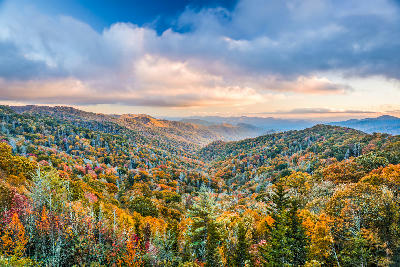
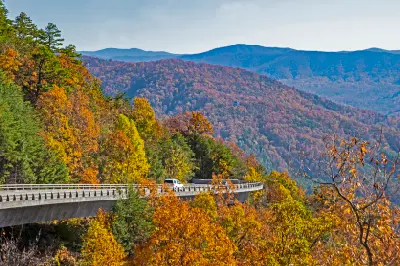
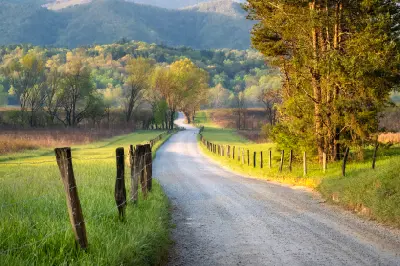
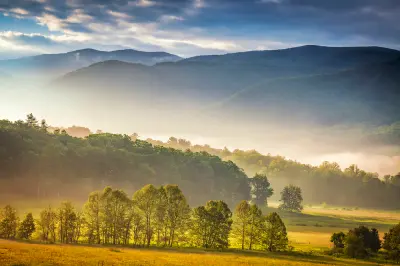
The Great Smoky Mountains form the most densely forested section of the southern Appalachian Mountains, defined by layered ridgelines, broad valleys, humid atmospheric conditions, and continuous woodland extending across rolling mountain terrain. The landscape is shaped by elevation, moisture, and overlapping mountain forms rather than exposed alpine relief. The terrain transitions through forest corridors, mountain roads, river valleys, and rounded ridgelines, with elevation changes occurring gradually across the range. Dense vegetation covers most of the terrain, softening the structure of the mountains and creating continuous visual texture. Seasonal conditions strongly influence visibility and colour. Fog, rain, low cloud, and atmospheric haze frequently separate ridgelines into layers, while autumn introduces extensive foliage variation across the mountains.
Gallery
Key POIs in Great Smoky Mountains
Nearby Places
View all on mapAppalachian Waterfalls & Forests
area district — 35.6 km
Appalachian & Smoky Mountains
Dry Falls
landmark — 64.4 km
Appalachian & Smoky Mountains
Sliding Rock
water feature — 71.8 km
Appalachian & Smoky Mountains
Looking Glass Falls
landmark — 74.0 km
Appalachian & Smoky Mountains
Whitewater Falls
landmark — 76.9 km
Appalachian & Smoky Mountains
Blue Ridge Parkway
area district — 108.7 km
Appalachian & Smoky Mountains
Overview
The Great Smoky Mountains are structured as a layered forest mountain system, where atmosphere and repetition define the landscape. Unlike alpine mountain environments, the terrain is visually softened by dense vegetation and humid air conditions. The mountain range is composed of rounded ridges and valleys extending across large distances. Roads, overlooks, and valleys reveal changing layers of terrain rather than isolated peaks or singular geological formations. For photographers, the region functions through depth and atmospheric separation. Compositions are built from repeating ridgelines, shifting visibility, forest textures, and changing weather conditions. The visual structure is defined by overlapping mountain layers. Light and haze create tonal separation between ridges, while forests unify the landscape into a continuous visual system.
Key photography subjects
- Layered forested ridgelines fading into atmospheric haze
- Broad mountain valleys and rolling terrain
- Dense woodland textures across mountain slopes
- Fog and low cloud interacting with ridge systems
- Seasonal autumn colour across forests and valleys
- Scenic roads and overlooks following mountain contours
- Light shaping depth and visibility across the range
Workshops in Great Smoky Mountains
Autumn in Eastern Sierra

Oregon Coast Adventure Photography Workshop
Autumn in Utah Badlands