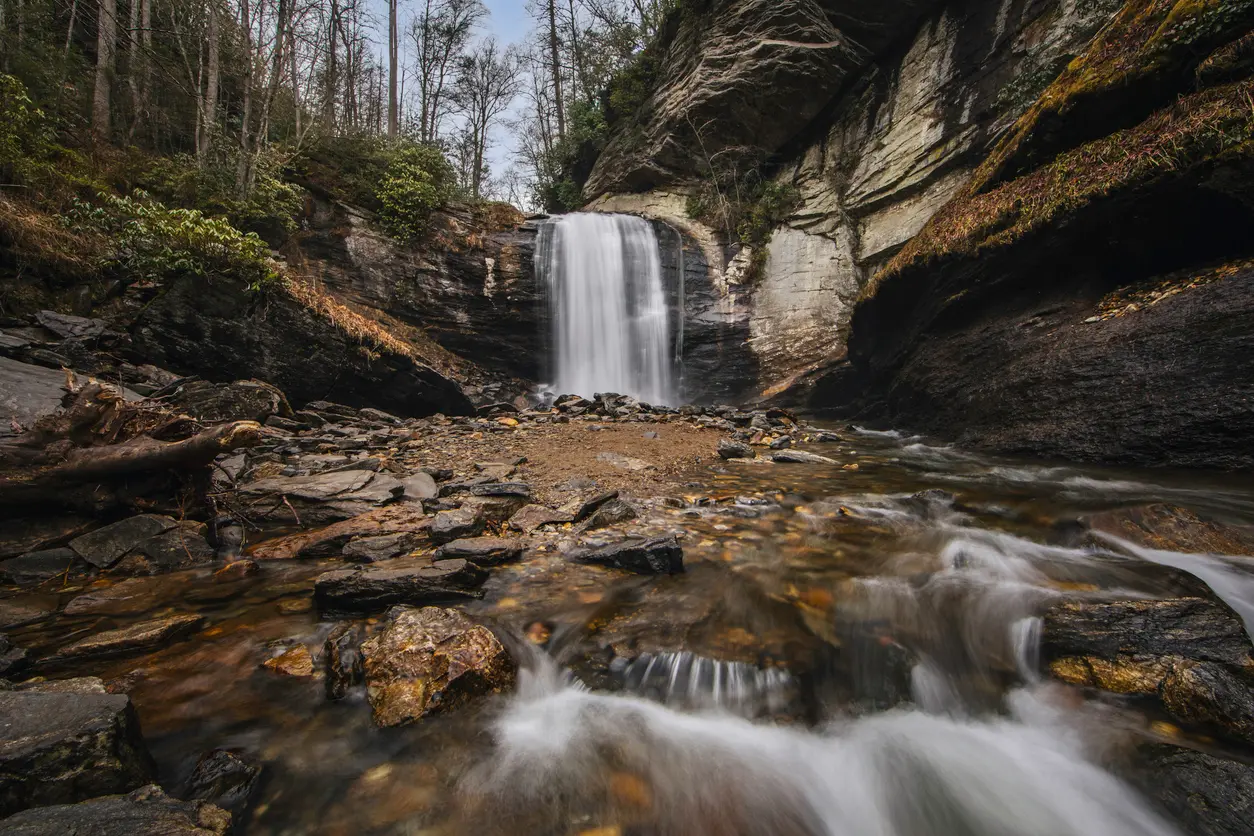
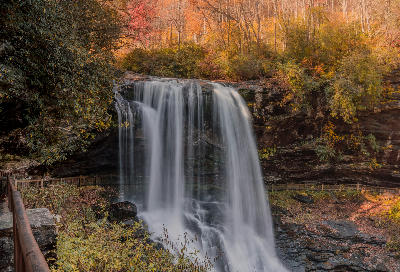
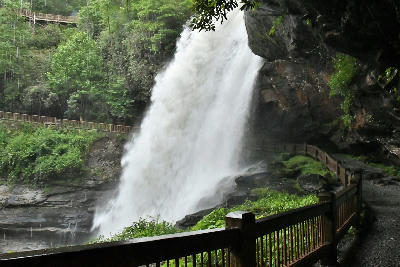
Looking Glass Falls flows through a rocky Appalachian gorge in Pisgah National Forest, North Carolina.
The Appalachian Waterfalls & Forests region is defined by dense woodland, flowing river systems, and waterfalls positioned within enclosed forest terrain across the southern Appalachian Mountains. Unlike open mountain ridge systems, the landscape here functions at a more intimate scale, where water, vegetation, rock surfaces, and filtered light combine within narrow valleys and forest corridors. The terrain transitions through river gorges, moss-covered rock formations, forested slopes, and enclosed stream systems. Elevation changes occur within confined terrain, creating layered foreground environments shaped by water flow and vegetation density. Seasonal conditions strongly influence colour, water volume, and atmospheric clarity. Rain, humidity, and filtered forest light frequently soften contrast and create reflective surfaces across rock, water, and foliage.
Gallery
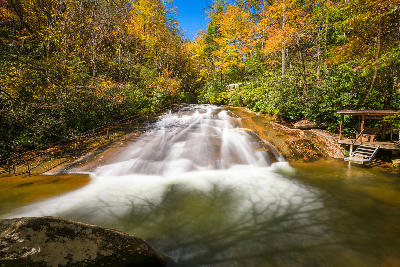
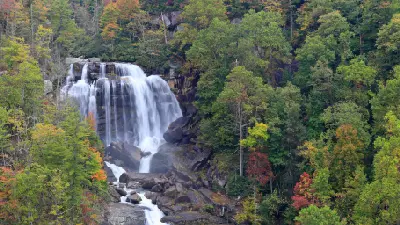
Key POIs in Appalachian Waterfalls & Forests
Nearby Places
View all on mapNewfound Gap
landmark — 29.6 km
Appalachian & Smoky Mountains
Morton Overlook
landmark — 29.9 km
Appalachian & Smoky Mountains
Great Smoky Mountains
area district — 35.6 km
Appalachian & Smoky Mountains
Kuwohi (Clingmans Dome)
landmark — 36.0 km
Appalachian & Smoky Mountains
Cades Cove
landmark — 65.7 km
Appalachian & Smoky Mountains
Foothills Parkway
landmark — 66.6 km
Appalachian & Smoky Mountains
Blue Ridge Parkway
area district — 75.6 km
Appalachian & Smoky Mountains
Overview
The Appalachian Waterfalls & Forests region is structured as an enclosed forest-water system, where composition is built around movement, texture, and layered foreground detail rather than distant landscape scale. Waterfalls and streams are distributed through narrow valleys and forest corridors, creating repeated compositional opportunities within dense woodland terrain. Features such as cascades, pools, wet rock surfaces, and moss-covered formations dominate the visual structure. For photographers, the region functions through foreground-rich composition. Water movement, layered vegetation, rock textures, and filtered light combine to create enclosed scenes with high visual density. The visual structure is defined by containment and atmosphere. Forest cover compresses the landscape into intimate compositions, while moisture and low light shape contrast, colour, and visibility.
Key photography subjects
- Waterfalls and cascades within forested terrain
- Flowing streams interacting with rock formations
- Moss-covered surfaces and wet woodland textures
- Enclosed river valleys and forest corridors
- Layered foreground compositions using water and vegetation
- Filtered forest light and atmospheric moisture
- Seasonal foliage surrounding river systems and waterfalls
Workshops in Appalachian Waterfalls & Forests
Autumn in Eastern Sierra

Oregon Coast Adventure Photography Workshop
Autumn in Utah Badlands