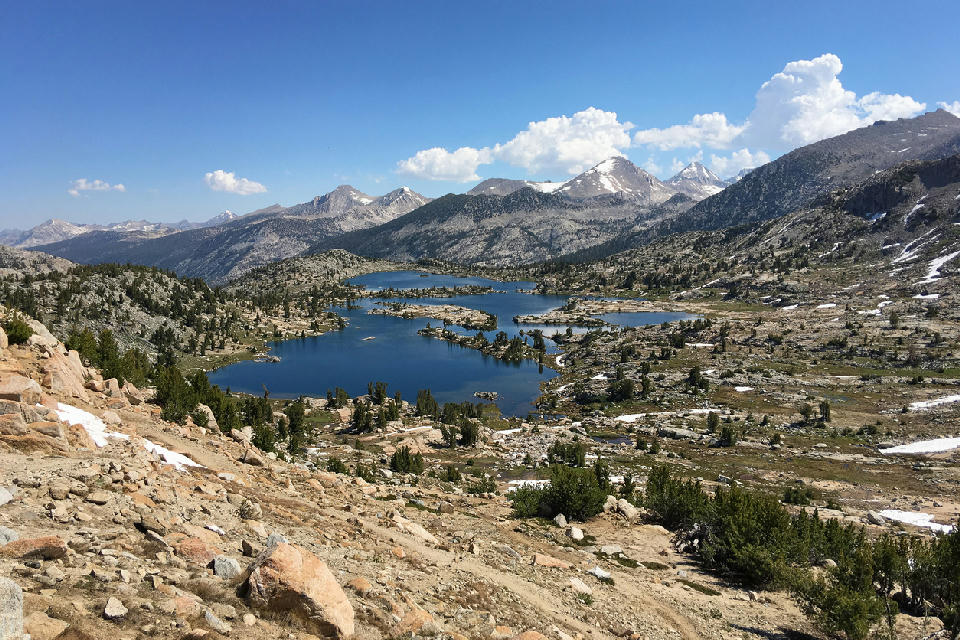
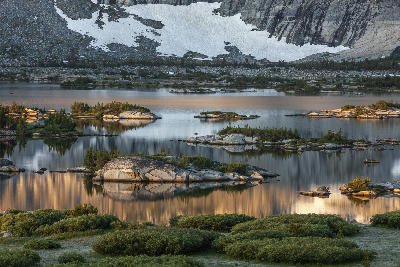
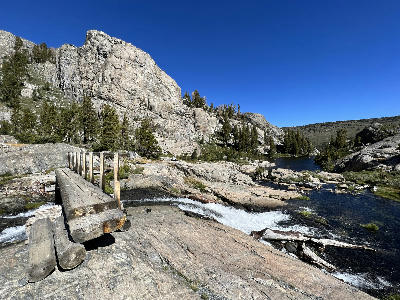
High alpine lake system along the John Muir Trail in the Ansel Adams Wilderness, with granite ridgelines and scattered island formations defining the Sierra basin landscape.
The alpine basins of the Ansel Adams Wilderness extend across the eastern Sierra Nevada, defined by glacial lakes, granite ridgelines, and high-elevation terrain shaped by ice and erosion. The landscape forms a continuous high-country system where lakes, peaks, and basins are distributed across a broad alpine plateau rather than concentrated around a single summit. The terrain transitions between granite basins, exposed ridgelines, alpine lakes, and sparse vegetation near and above the tree line. Elevation remains consistently high, with terrain opening outward across interconnected basins rather than rising sharply in a single direction. Seasonal conditions strongly influence access, water levels, and surface clarity. Snowmelt feeds lake systems, while changing light and atmospheric conditions affect reflection, contrast, and visibility across the landscape.
Gallery
Key POIs in Ansel Adams Wilderness
Nearby Places
View all on mapHorseshoe Lake
water feature — 17.8 km
Eastern Sierra Nevada
Lake Mary
water feature — 19.3 km
Eastern Sierra Nevada
Mammoth Lakes Basin
area district — 24.4 km
Eastern Sierra Nevada
Tuolumne Meadows & Tioga Pass
area district — 30.1 km
Yosemite National Park
Half Dome
landmark — 30.6 km
Yosemite National Park
Olmsted Point
landmark — 30.9 km
Yosemite National Park
Tenaya Lake
water feature — 31.1 km
Yosemite National Park
Tioga Pass
landmark — 31.7 km
Yosemite National Park
Overview
This region is structured as a network of alpine basins, where glacial processes have created a series of interconnected lakes and ridgelines across high-elevation terrain. Unlike vertical mountain systems, the landscape operates through distribution rather than concentration. Lakes such as Thousand Island Lake and Ediza Lake sit within natural basins beneath surrounding peaks, forming repeated compositional opportunities across the terrain. For photographers, the area functions through basin-to-basin movement. Each location offers a variation of the same structural relationship: reflective water in the foreground, rising granite peaks beyond, and open alpine terrain connecting the system. The visual structure is defined by distributed alpine composition. Rather than a single focal point, the landscape provides multiple balanced compositions across lakes, ridges, and basins.
Key photography subjects
- Alpine lakes forming reflective foreground surfaces
- Granite peaks and ridgelines surrounding basin environments
- Layered compositions across water, rock, and elevation
- Open alpine terrain above the tree line
- Repeated basin structures across connected landscapes
- Subtle variation in light and atmospheric clarity
- Seasonal snow and water levels shaping compositions
Workshops in Ansel Adams Wilderness
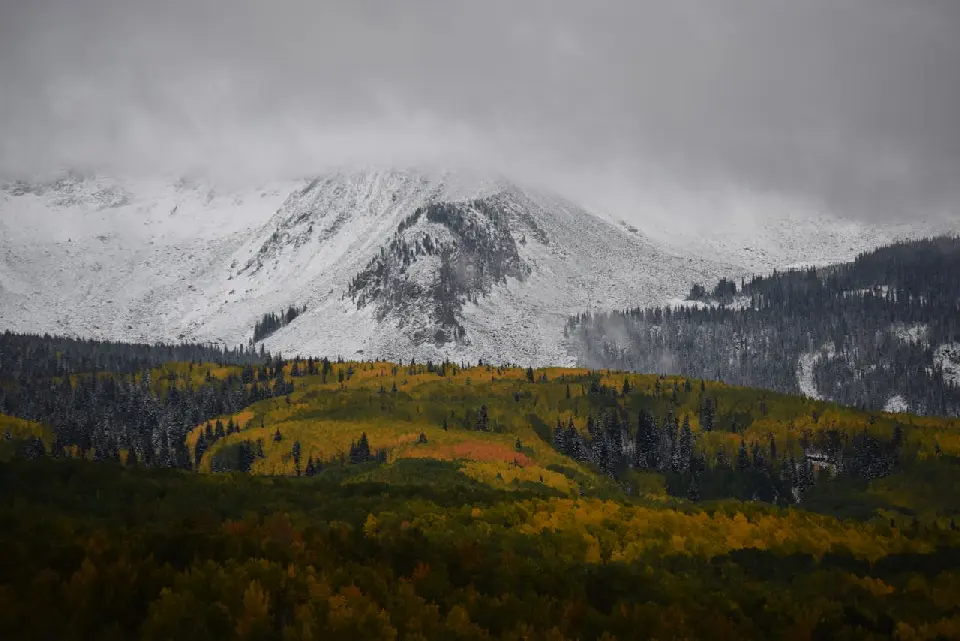
Colorado Fall Color Photography Art Retreat

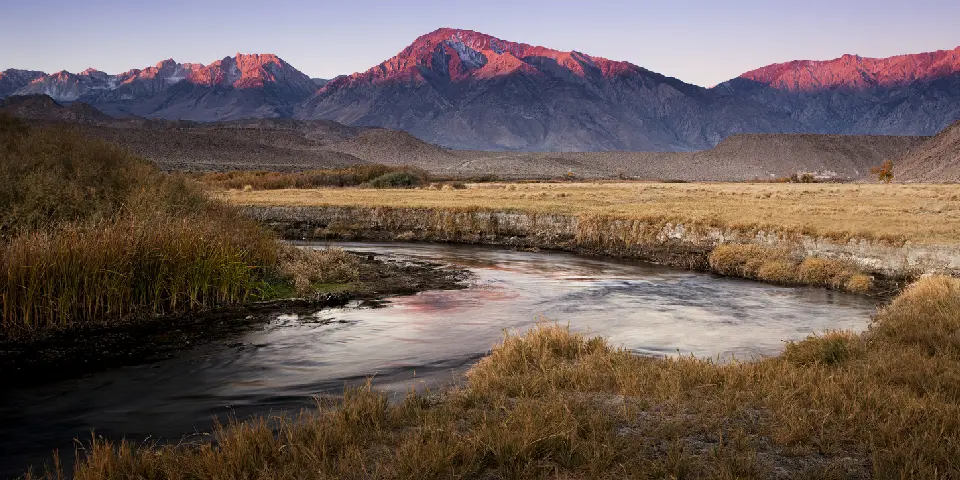
Autumn in Eastern Sierra

Oregon Coast Adventure Photography Workshop
Autumn in Utah Badlands