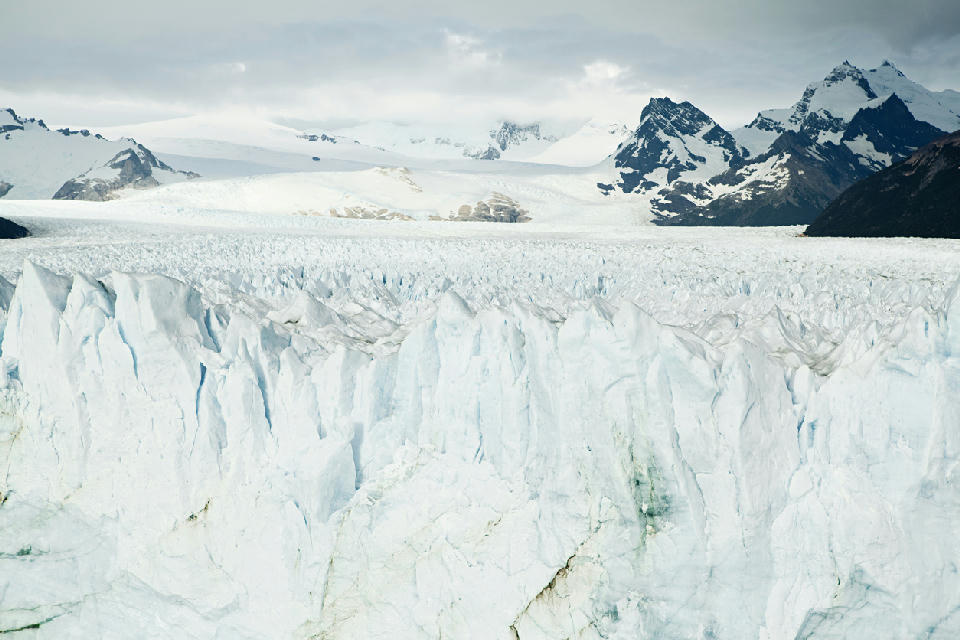
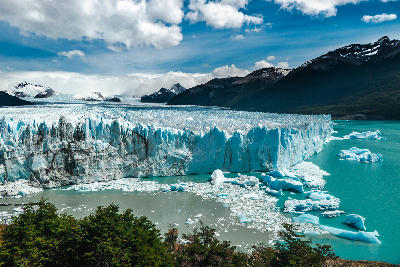
Detail of Upsala Glacier’s fractured ice front with surrounding peaks in Los Glaciares National Park near El Calafate.
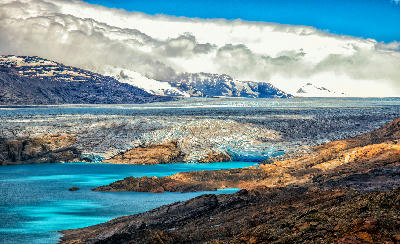
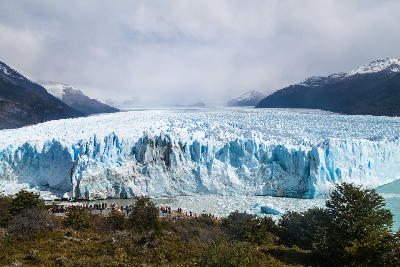
The Southern Patagonian Ice Field extends across Los Glaciares National Park in southern Argentina, defined by large outlet glaciers descending into expansive glacial lakes. The landscape is structured by ice fields, broad water systems, and distant mountain ridges shaped by glacial movement rather than vertical mountain dominance. The terrain transitions between glacier fronts, open water, icebergs, and wide lake basins such as Lago Argentino. Elevation changes are gradual compared to alpine systems, with the landscape opening outward rather than rising sharply. Seasonal conditions influence ice movement, water clarity, and atmospheric visibility. Wind, cloud systems, and light interact across large open surfaces, shaping contrast between ice, water, and distant terrain.
Gallery
Key POIs in Los Glaciares National Park
Nearby Places
View all on mapPatagonia Steppe (Ruta 40)
area district — 26.9 km
Patagonia
Laguna Azul
water feature — 70.7 km
Patagonia
Estancia Landscapes
landmark — 76.0 km
Patagonia
Lago Sarmiento
water feature — 82.5 km
Patagonia
Mirador Las Torres
landmark — 83.2 km
Patagonia
Torres del Paine
landmark — 85.8 km
Patagonia
Cuernos del Paine
landmark — 91.1 km
Patagonia
Lago Nordenskjöld
water feature — 92.2 km
Patagonia
Overview
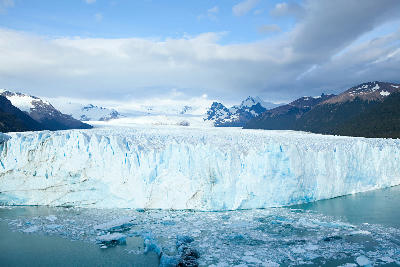
The region is organised around the Southern Patagonian Ice Field, where glaciers flow outward into large lake systems. Unlike compact mountain massifs, this landscape operates through scale and spread, with glacial systems extending across wide geographic areas. Major glaciers such as Perito Moreno Glacier and Upsala Glacier terminate directly into lakes, forming dynamic ice fronts and floating ice fields. For photographers, the landscape functions through lake-edge perspectives. Foregrounds are built from water, icebergs, and shoreline elements, while glacier walls and distant mountains provide structural backdrops. The visual structure is defined by ice-to-water interaction. Glaciers, lakes, and floating ice create compositions built on scale, movement, and separation across open space.
Key photography subjects
- Glacier fronts descending into large glacial lakes
- Icebergs floating across open water surfaces
- Broad lake systems with distant mountain backdrops
- Ice field textures and fractured glacier surfaces
- Layered compositions across water, ice, and horizon
- Reflections and tonal variation across large-scale scenes
- Weather systems moving across open glacial landscapes
Workshops in Los Glaciares National Park
No upcoming workshops scheduled for Los Glaciares National Park at this time.
Check back soon or explore other destinations.