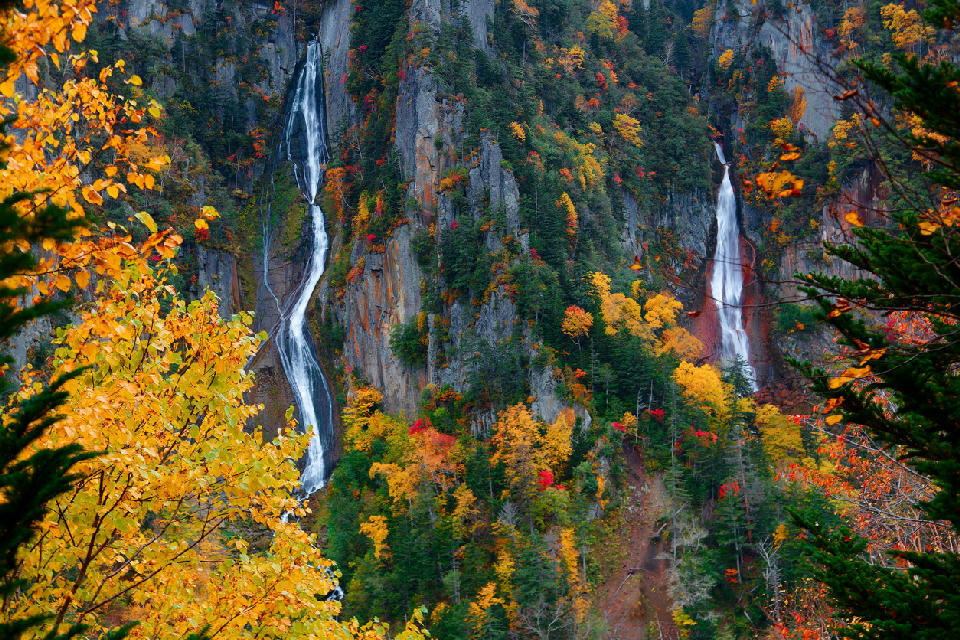
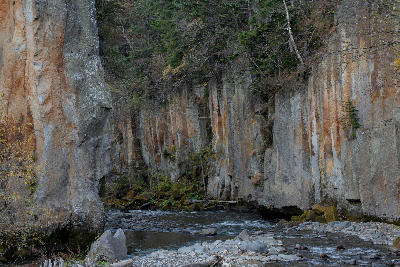
Ginga and Ryusei Waterfalls cascading down sheer rock walls in Sounkyo Gorge, framed by autumn color in Daisetsuzan National Park.
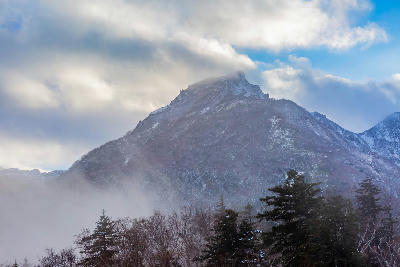
Daisetsuzan National Park is a mountainous region in central Hokkaido defined by volcanic peaks, broad alpine plateaus, and high-elevation terrain shaped by geothermal activity and erosion. The park forms the core of Hokkaido’s interior highlands, where volcanic systems create rounded summits and expansive upland landscapes rather than sharp alpine ridgelines. Its spatial identity is defined by elevation and exposure across open mountain terrain. The terrain transitions between volcanic summits, rolling alpine plateaus, geothermal areas, and forested lower slopes. Elevation increases gradually toward high-altitude zones, where exposed terrain replaces dense vegetation. Seasonal conditions strongly influence surface appearance. Snow cover, autumn vegetation, and atmospheric clarity define contrast across open terrain, while weather systems move freely across the elevated landscape.
Gallery
Key POIs in Daisetsuzan National Park
Nearby Places
View all on mapShirahige Waterfall
water feature — 29.2 km
Hokkaido
Blue Pond
water feature — 30.9 km
Hokkaido
Shikisai no Oka
landmark — 42.6 km
Hokkaido
Ken & Mary Tree
landmark — 43.9 km
Hokkaido
Patchwork Road
landmark — 44.0 km
Hokkaido
Seven Stars Tree
landmark — 46.7 km
Hokkaido
Farm Tomita
landmark — 47.5 km
Hokkaido
Biei & Furano
area district — 55.1 km
Hokkaido
Overview
Daisetsuzan is structured as a large volcanic highland system, where multiple peaks and plateaus are connected across a broad elevated area. Unlike steep alpine environments, the terrain is more open and continuous, allowing movement across ridgelines and plateaus without abrupt vertical barriers. Geothermal activity and volcanic history have shaped the landscape, creating features such as fumaroles, hot spring areas, and exposed rock surfaces. Lower elevations transition into forested terrain, while upper zones remain largely open. The visual structure is defined by elevation and openness. Broad plateaus and rounded peaks create compositions based on horizon, scale, and exposure rather than vertical confinement or isolated subjects.
Key photography subjects
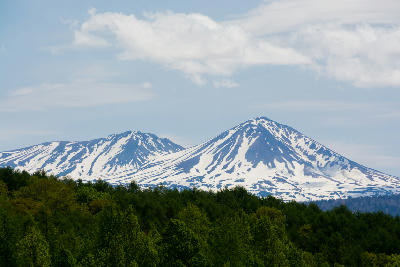
- Volcanic peaks rising from open alpine terrain
- Broad plateaus extending across high elevations
- Rolling ridgelines connecting mountain summits
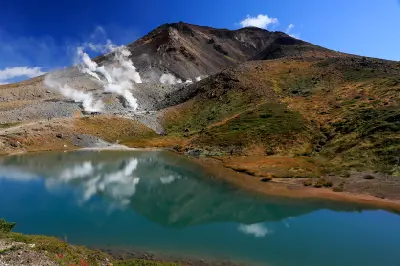
- Geothermal areas with exposed rock and steam
- Open foregrounds leading to elevated horizons
- Seasonal colour changes across alpine vegetation
- Low cloud and weather systems moving across high terrain
Workshops in Daisetsuzan National Park
No upcoming workshops scheduled for Daisetsuzan National Park at this time.
Check back soon or explore other destinations.