
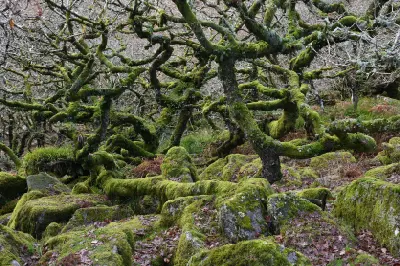
Ancient sessile oak trees with twisting, moss-covered branches rise among lush green boulders in Wistman's Wood, Dartmoor National Park, Devon, England.
Wistman's Wood is an ancient upland oak woodland in Dartmoor's West Dart valley, known for its twisted trees, moss-covered granite boulders and dense growth of lichens. The small woodland occupies a sheltered slope beneath open moorland, creating a striking contrast between exposed grassland and tangled vegetation. Its distinctive forms and atmospheric setting make it an important woodland photography subject.
50.57794, -3.96121
Gallery






Quick Facts
Access
Moderate Hike
45–90 min
Elevation Gain
80 m
Best Light
Soft cloud light preserves detail in moss, lichens and twisted branches, while morning mist can separate the woodland from the surrounding moorland.
Why This Light
Season
Seasonally Distinct
Summer brings a green canopy, thick moss and leafy vegetation around the twisted oak trunks, with filtered light reaching the woodland margins. Winter exposes more of the branching structure, while damp conditions, mist and muted moorland vegetation emphasise the moss-covered boulders and ancient tree forms.
Crowds
Busy Midday
Restrictions
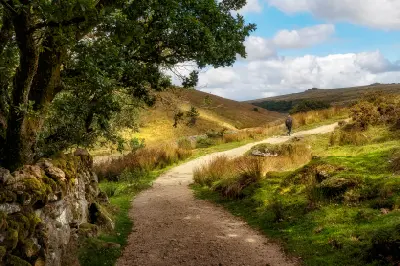
Wistman's Wood is a protected and ecologically sensitive ancient woodland within a Site of Special Scientific Interest. Access from Two Bridges follows a moorland path through the West Dart valley, with uneven, potentially muddy ground and exposed sections. Visitors are strongly encouraged to remain outside the woodland and photograph from established paths and surrounding viewpoints. Entering the wood can damage fragile mosses, lichens, tree roots and ground vegetation. Avoid climbing over boulders or approaching trees for close-up compositions. Weather conditions can change rapidly on the open moor, and visibility may deteriorate in mist.