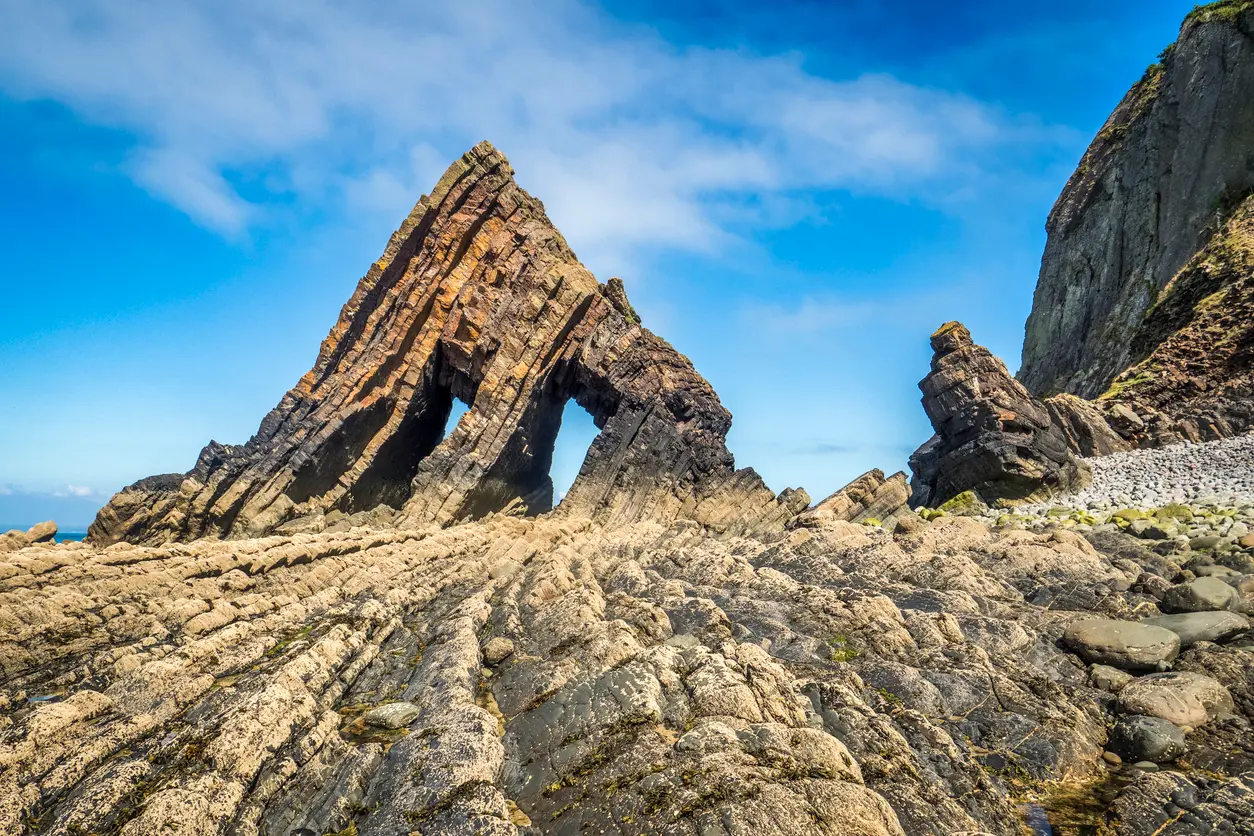
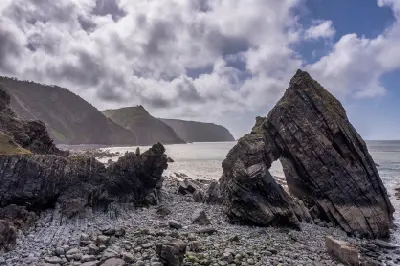
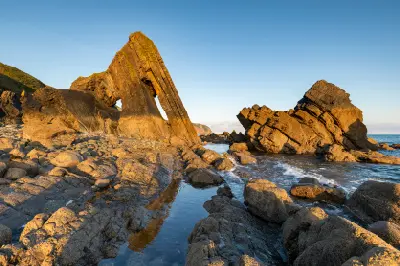
Blackchurch Rock's dramatic twin sea arches rising above the rocky shoreline at Mouthmill Beach, North Devon, England.
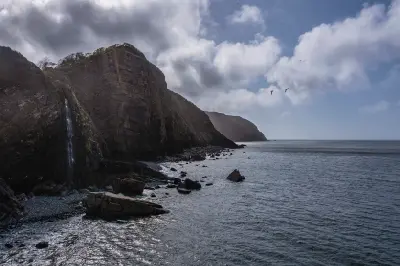
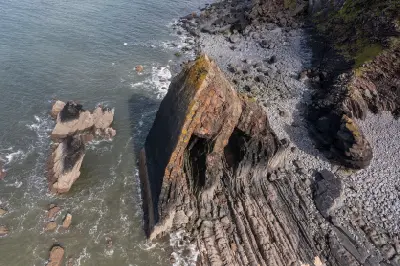
Blackchurch Rock is a distinctive double-arched rock formation at Mouthmill Beach on North Devon's rugged coastline, near Hartland. Its dark, layered rock rises from a boulder-strewn foreshore, with two natural openings carved by marine erosion. The surrounding cliffs, tidal rock platforms and Atlantic surf provide opportunities for dramatic coastal compositions and detailed geological photography.
51.01397, -4.42644
Gallery
Quick Facts
Access
Moderate Hike
45–90 min
Elevation Gain
100 m
Best Light
Late light defines the arches and layered rock, while overcast skies preserve detail in the dark formation and bright surf.
Why This Light
Season
Weather-Dependent
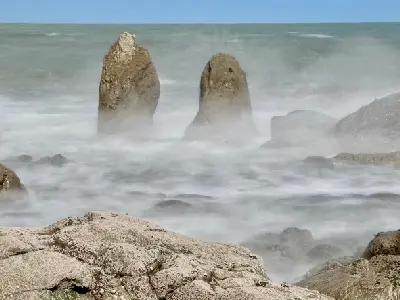
Summer brings green vegetation along the wooded approach and surrounding cliffs, with lower-angle evening sunlight occasionally illuminating the rock and exposed foreshore. Winter brings muted cliff vegetation, stronger Atlantic swell and more frequent white water around the arches, although rough seas can make the beach unsafe.
Crowds
Usually Quiet
Restrictions
Blackchurch Rock is reached via a woodland footpath from the Brownsham area, descending towards the remote beach at Mouthmill. The route includes uneven ground, muddy sections and a climb on the return journey. The final approach crosses a rocky foreshore with loose boulders and slippery surfaces. The rock formation is best approached at low tide, when more of the beach and surrounding platforms are exposed. Rising tides can restrict movement along the shore, while large Atlantic swells may make the beach dangerous even at low water. Check tide times and sea conditions before visiting, allow sufficient time for the return walk and avoid standing beneath unstable cliffs or rock arches.